Five services people search for separately
Qwest Industries UK LTD, Leeds and West Yorkshire · Solar, battery storage, electric heating, EV charging · qwestindustries.co.uk
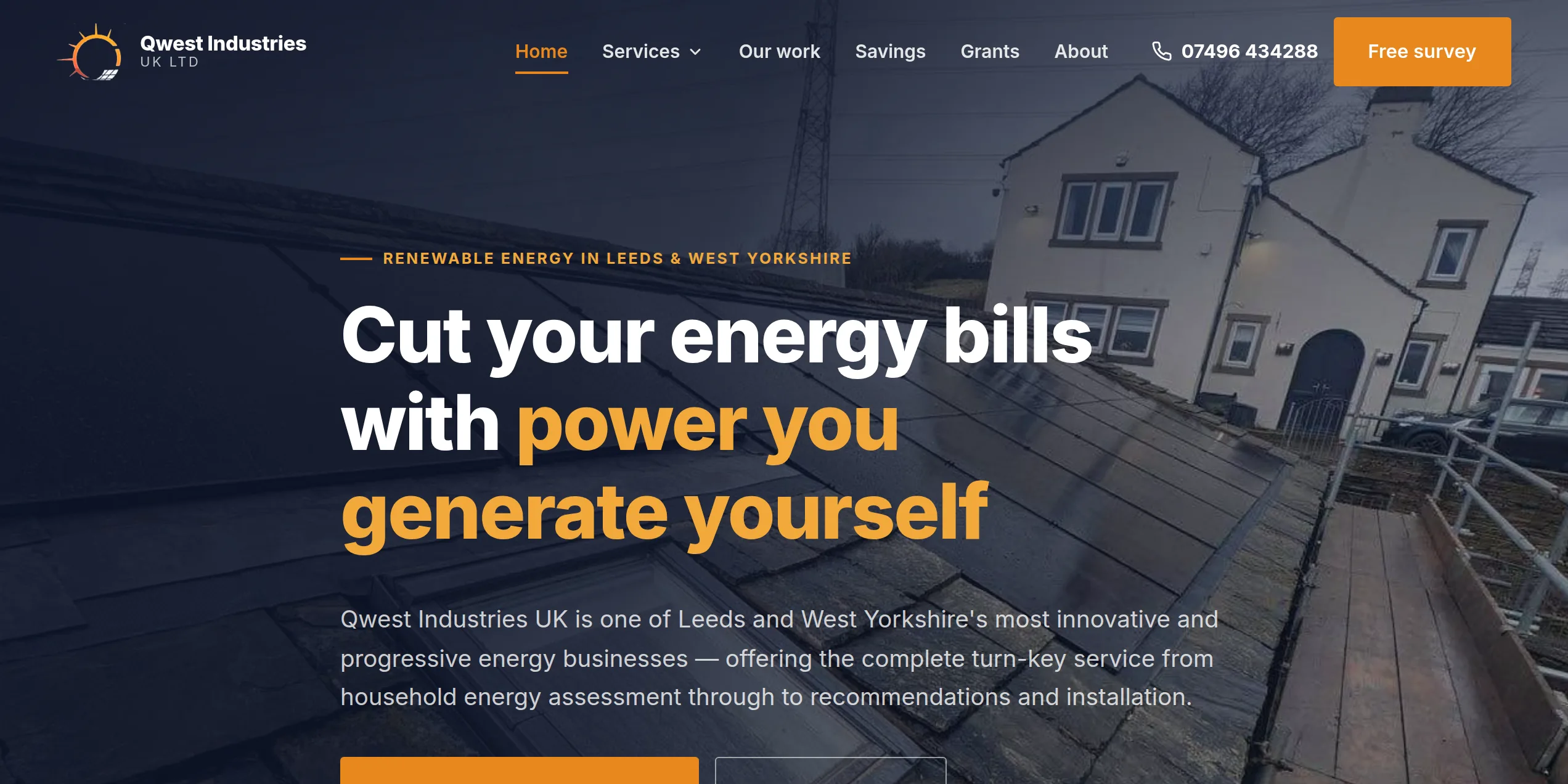
Qwest Industries came through a referral. The ask was simple enough on the face of it: more visibility around Leeds and West Yorkshire.
The complication was that they do not sell one thing. They sell five, and the people buying them are not the same people.
Five services, five different customers
Solar panels. Battery storage. Electric heating. Electric car charging. Hot water diversion. One company, five services, and almost no overlap in who searches for each one.
Somebody pricing up a battery to go with panels they already own is not the same person typing "electric car charger installer" into their phone. They want different pages, different answers, and they arrive with different questions.
The usual outcome for a business like this is a single services page listing all five with a paragraph each. It reads fine to a human who is already on the site. It gives Google almost nothing to rank for any individual service, because no page is actually about any one of them.
A page for each one, written for the search
So each service got its own page, written around what somebody would type rather than the language the trade uses internally. Solar, batteries, heating, EV charging and the iBoost hot water diverter each have somewhere to land that is genuinely about that thing.
They still link to each other, because the actual selling point is that the parts work together. Panels generate, the battery stores what the house does not use, the diverter puts the rest into the hot water tank, and the car charges on whatever is left. The site is structured so somebody who arrives for one service can see the rest without being sold at.
The Leeds and West Yorkshire part is spelled out properly too, rather than left for Google to guess from a mention in a paragraph somewhere. If you want to come up in your own area, the site has to be clear about where that area is.
Two ways in, for two kinds of visitor
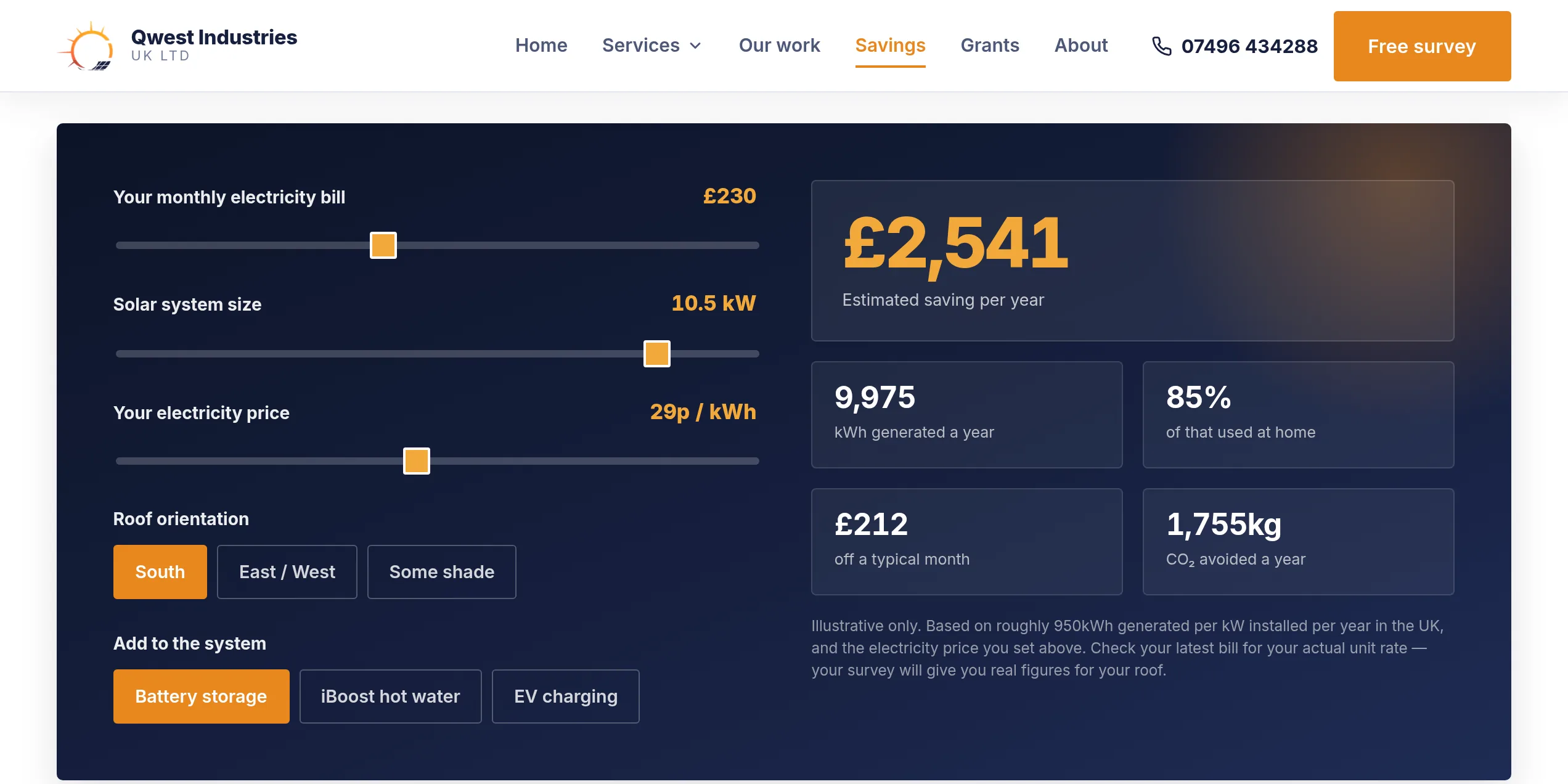
The thing most people will remember about the site is the savings calculator. Three sliders for your monthly bill, system size and unit rate, buttons for roof orientation and what else you want in the system, and a running estimate of what comes off your bill each year.
That exists because of what renewable energy enquiries actually look like. Nobody books a survey on a whim. They spend weeks working out whether the numbers stack up at all, and most of that happens before they will give anyone their phone number.
A form on its own asks for commitment from somebody who has not decided yet. So the calculator handles that half: it gives them something useful on the first visit, and gets them to the point where booking a survey is the obvious next step.
It is labelled as illustrative, with the assumptions stated on the page, and it says plainly that a real survey gives the accurate figure. That matters. A calculator that flatters the numbers gets found out at the quote stage and costs more trust than it won.
For the ones who are ready, the quote form asks the questions that actually matter. Which services they want, what sort of property it is, and what they currently spend a month. That means Qwest open a real enquiry they can price, rather than a name and a note saying please call me.
Their own roofs, not stock photography
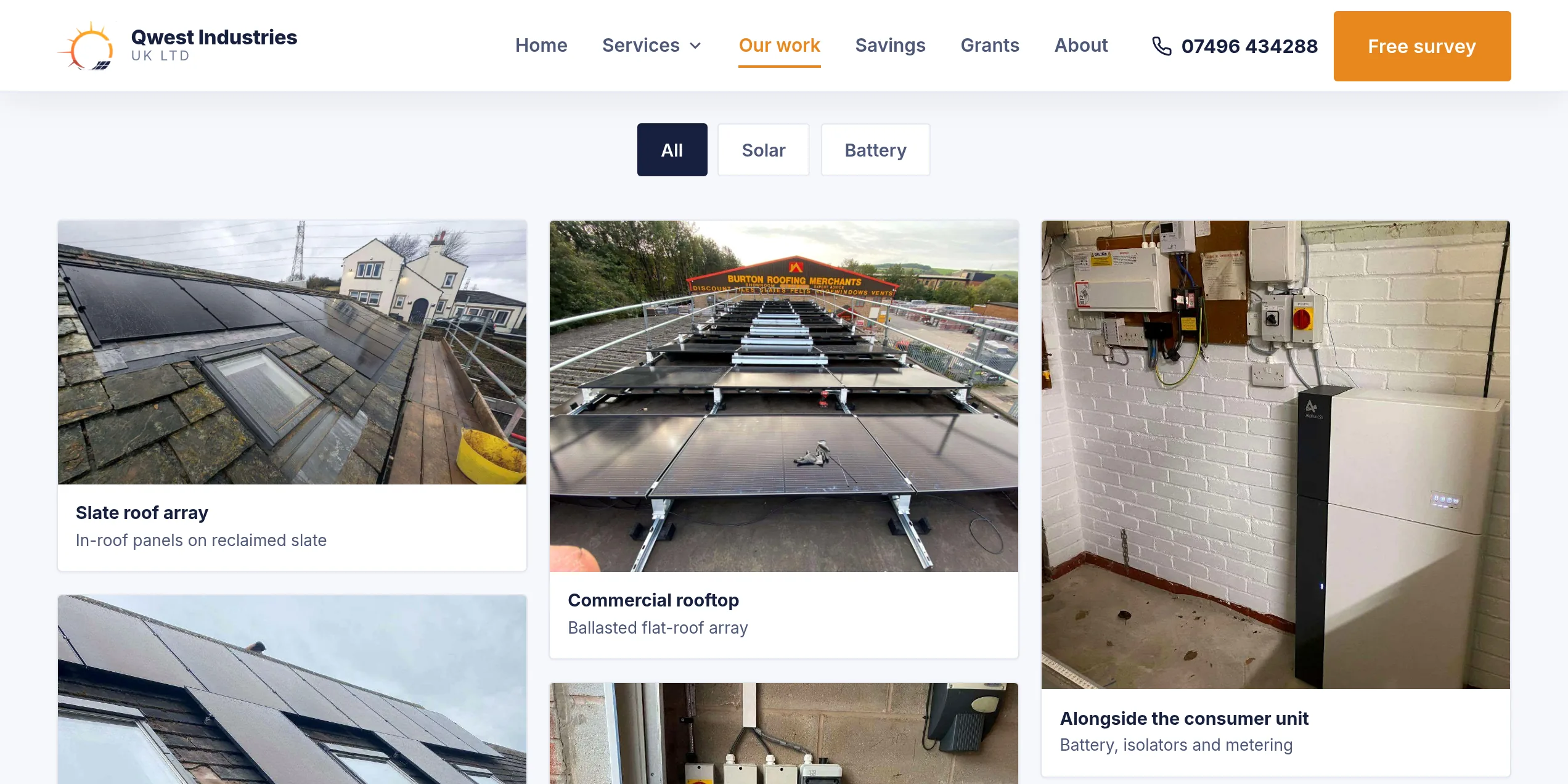
Every install photo on the site is theirs. Panels on reclaimed slate around existing rooflights, a ballasted array on a flat commercial roof, battery units wall-mounted in a garage and floor-standing in a basement.
Stock photography is the fastest way to look like every other installer in the county. Real photos of awkward roofs do something a stock image cannot, which is prove they have done this before on a roof like yours.
Quick on a bad phone signal
A lot of the people looking at this site are standing in a driveway or sitting in a van, on half a bar of signal, deciding whether to bother ringing. So the site is built to open straight away rather than make them wait.
It is the least glamorous part of the job and the one most likely to cost you an enquiry. People do not wait for a slow site. They go back and click the next installer on the list.
Where it stands
The site is live and Google has it. It is too new to claim rankings, and I am not going to invent them.
What can be said is that the structural work is done: five services that can each be found on their own terms, a reason for somebody to engage before they are ready to ring, and honest proof of work. The visibility follows from that, and it takes a few months rather than a few weeks.
No ranking or enquiry figures are claimed here. The site went live recently and local search positions take months to settle, so anything quoted this early would be guesswork.
If your business sells several things to several different sorts of customer, one page listing them all is usually the thing holding you back. Each service needs somewhere to land that is genuinely about it.
Qwest Industries was a custom build, priced per project, because it needed multiple service pages and an interactive tool. If you need something smaller, the Starter plan is a managed one page site from £20 a month.